Not so long ago in Venice…
AB: I don’t think anyone has ever used this telescope!
Me: Really?
AB: Yup, it has never been adjusted *tinkers with the lens for about 45 minutes* Oh wow, I can see the moon!
Me: Cool! Do you think it would be possible to photograph the moon through the telescope?
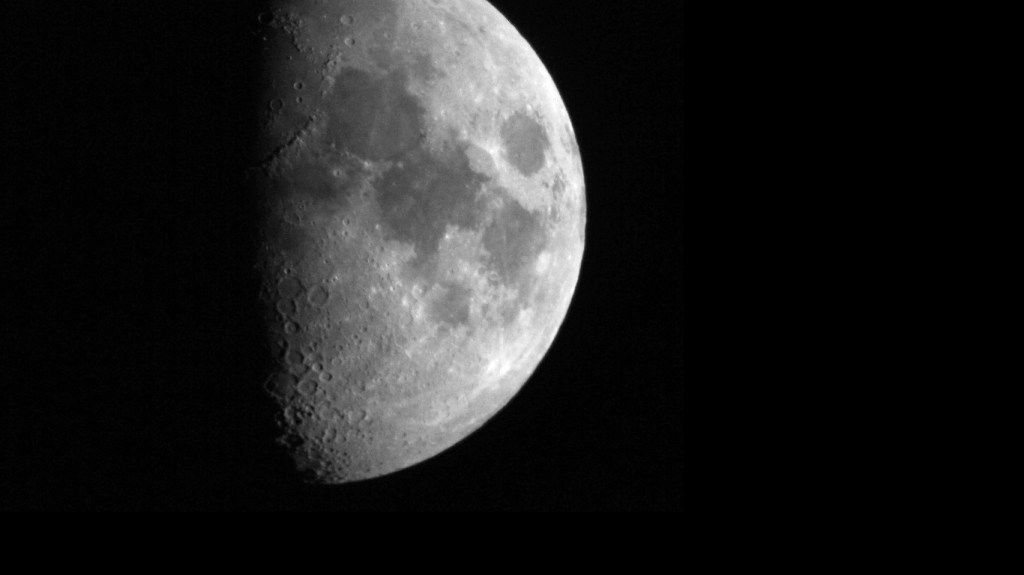
And so began an hour of squatting at the low end of a telescope in order to capture the moon using our compact cameras: Me with my Fuji x100 and AB with his Canon PowerShot S95.

We took turns looking through the telescope. This was the first time I had ever seen a moon through a telescope!
When I was small, I used to stare at the moon while in the backseat of my dad’s car and wonder how was it possible that the moon was able to keep following us.
Happy to know that I wasn’t the only one who thought so! Here is a clear explanation by a Physics professor on Wired.com.
That night, I thought the opposite. It seemed like the moon was escaping from me every few seconds.
“That’s because the moon is moving,” said AB. “Actually, it’s mostly because we’re moving.”
The (earth’s) movement added to the challenge of photographing it through the lens of the telescope. To being with, it took several tries to get right the focus on the moon. Every 20 seconds or so, we had to gently nudge the telescope to see the moon in its dimpled entirety once more.

While waiting for me to have my fill of moon-spotting, AB was reading on the Internet.
AB: Did you know that the telescope was invented by Galileo in Venice?
Me: Really?
AB: You should write about this on your blog!
So, here’s a short history lesson on Galileo’s telescope invention and how it revolutionised our view of the universe:
Once upon a time… It was 1609.
Galileo heard of an invention by a Flemish spectacle maker, Hans Lipperhey, that enabled one to see distant objects as though they were nearby. Without having seen the gadget, Galileo soon assembled his own version of it by placing two glass lenses at the ends of a leather tube.

He went to Venice with his “optick tube” and demonstrated its use to the Senate of Venice on 25 August 1609. From atop St. Mark Campanile, he successfully showed how one could spot ships in the distance using the device. The government was impressed by his invention as this would enable the city to spot approaching pirates which were attacking Venetian merchant ships at that time.
After being paid by the Venetian Senate, Galileo continued to explore the heavens and its secrets.

In 1610, Galileo published Sidereus Nuncius (Sidereal Message / Starry Message) based on his observations. These included the discovery that the surface of the moon was not smooth and instead was dotted with craters and mountains, as well as Jupiter and its four moons.
The latter would lead to his most startling and revolutionary discovery: That the Earth was not at the centre of the universe.
His observations supported the Copernican theory that the sun was at the centre of the solar system. This was contrary to the teaching of the Roman Catholic Church which promoted a geocentric view based on how the bible’s account of how the world was created.
Based on his findings, Galileo wrote a book titled “Dialogue Concerning the Two Chief World Systems“. He was soon accused, in 1614, of heresy and forbidden by the church from teaching and spreading his theories.
In 1633, Galileo was called to appear before the Roman inquisition and was convicted and sentenced to life imprisonment for his heretical ideas. This was reduced to permanent house arrest. Galileo was also forced to revoke his support for the Corpernican theory and denounce heliocentrism, the belief that Earth orbited the Sun.

The above is a picture of the moon that AB took with the zoom function on his Canon compact camera. Pretty cool eh?
To read more about Galileo and telescope innovation:
- Museo Galileo: Here is where Galileo’s original telescope is kept and you can read more about it here
- Dialogue Concerning the Two Chief World Systems: Galileo’s revolutionary book was published in 1632
- National Geographic: Milestones in telescope innovation over the last 400 years
- The New York Times and The Daily Telegraph look back on 400 years of contemporary astronomy
 Angelina Hue
Leave a reply to Mabel Kwong Cancel reply