
We had arrived in Cambodia the night before and were groggy from sleep when we stepped out of Park Hyatt Siem Reap. In the hotel’s driveway was our driver, waiting in his remorque – the Cambodian equivalent of the Thai tuk-tuk.
Our first stop was Phnom Bok, a hill northeast of Siem Reap that’s about an hour’s drive away from the city centre.
Cruising in the remorque with the cool morning air in our hair was a refreshing start to our journey.

Along the way, we passed various temples such as Banteay Kdei and Pre Rup.
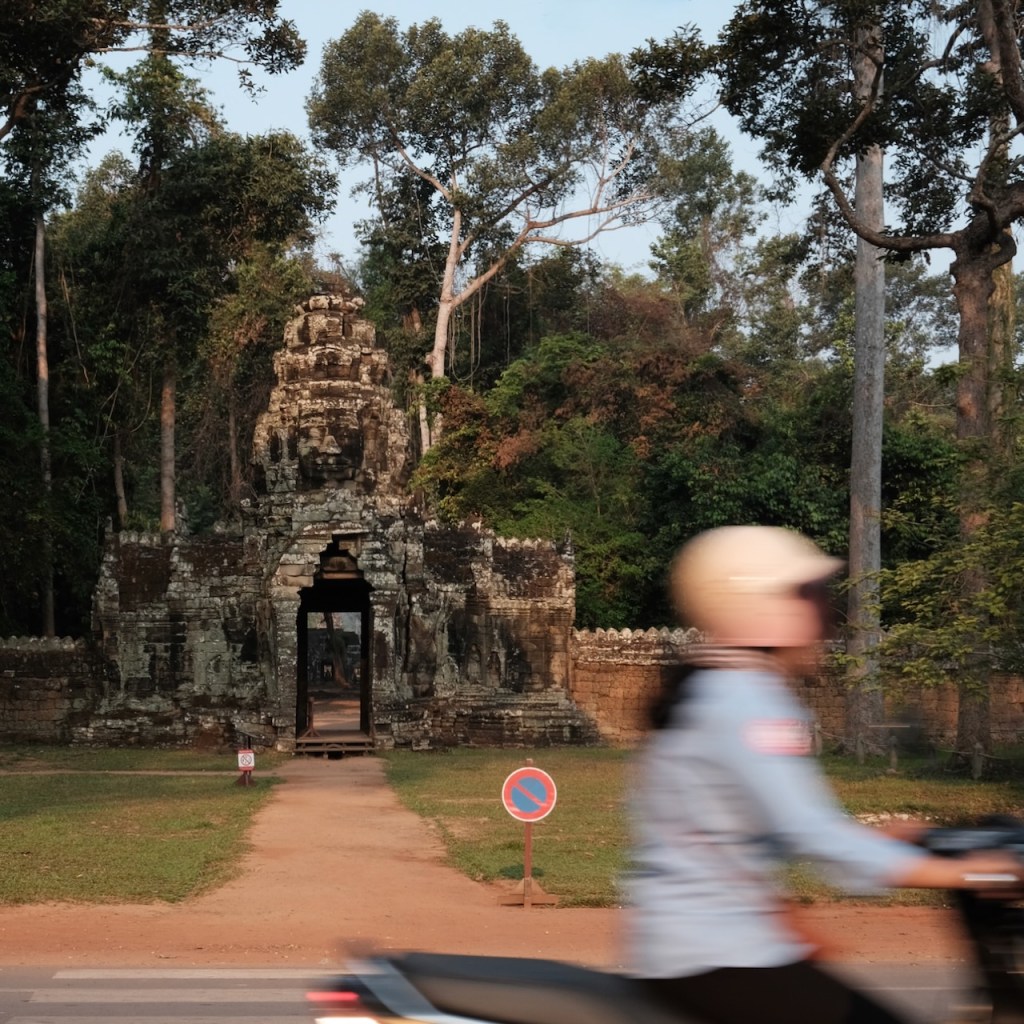
As we rode along Srah Srang, our driver pointed out that the name means “Royal Bath”. According to him, the king had over 1,000 concubines – hence the need for this large bathing pool! He gleefully pointed to a new structure in the middle that looks “white” because it’s covered in bird poop.

Some 45 minutes later, we arrived at the foot of Phnom Bok. At the top of the hill is a prasat (“temple” in the Khmer language) of the same name. Phnom Bok was one of three hilltop temples built in the late ninth century during the reign of King Yasovarman I when he moved his capital from Hariharalaya to Yasodharapura, known today as Angkor. Together with Phnom Krom and Phnom Bakheng, Phnom Bok is one of the oldest temples from the Angkorian era.
Seldom mentioned in travel guides, Phonm Bok is one of the lesser-known temples in the Angkor Archeological Park. It sits at an elevation of some 200 metres – well over double that of Phnom Bakheng which is popular for its sunset views. Phnom Bok’s remote location combined with its relative inaccessibility means that it sees few visitors.
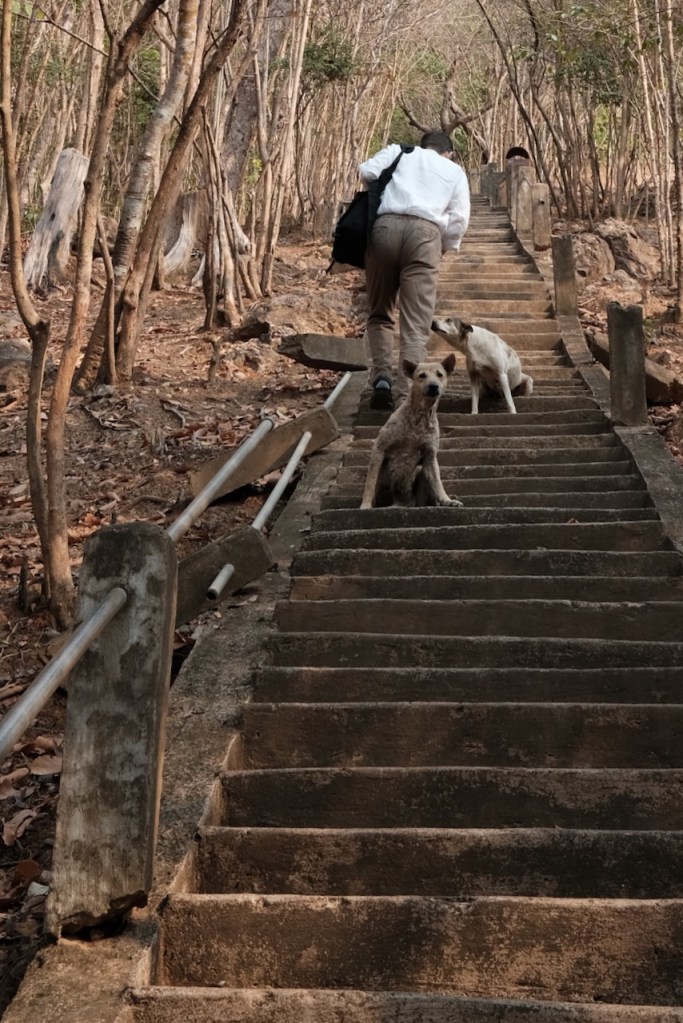
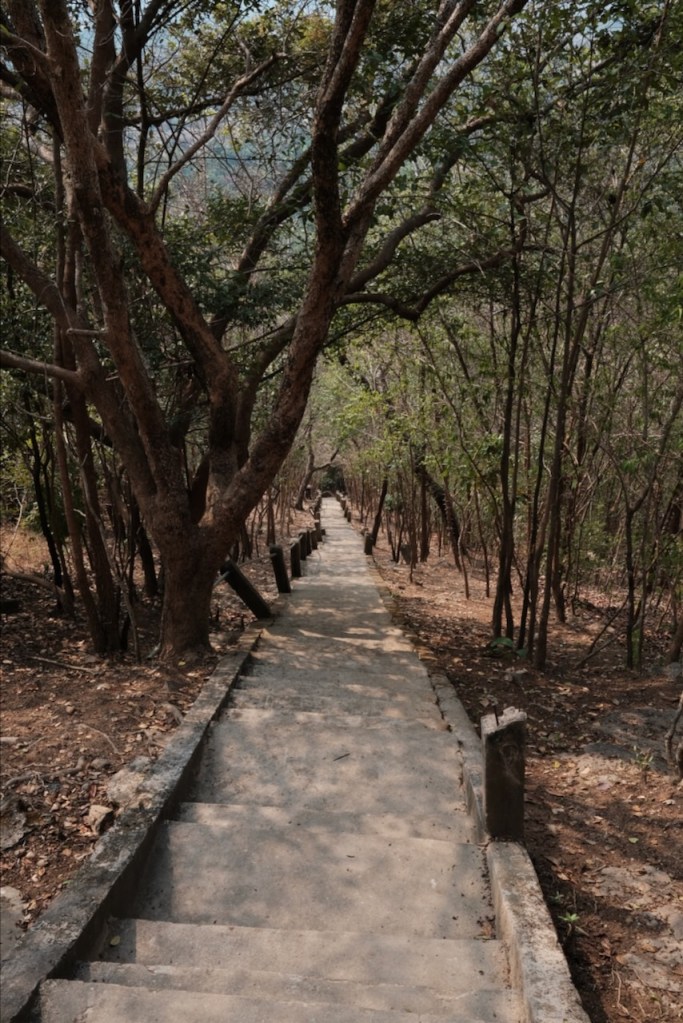
Alighting from the remorque, we walked up a dirt path to the bottom of a steep stairway of over 600 concrete steps. Climbing the stairs wasn’t difficult. But we were careful not to miss our footing as some parts of the iron guardrail were missing or collapsed.
Near the top of the stairs is a modest Buddhist monastery. Beyond it lies the main entry of Phnom Bok, flanked by two sandstone structures – each crowned with a frangipani tree and encircled by a jumble of stone blocks.
Even though I had already seen photos of Phnom Bok online, it was surreal to be there in person. To stand beneath these frangipani trees, with their white blooms dotting the otherwise bare branches, thriving among the crumbling remnants of an ancient civilization. It was as if the untold stories of the past lingered in the serene, mystical atmosphere.

Past the pair of sandstone libraries are three towers in varying states of decay. The towers pay tribute to the Hindu Trinity of gods, the Trimurti: Brahma, Shiva and Vishnu. The statues that were in the towers are now part of the extensive Asian arts collection at Musée Guimet in Paris.

Behind the towers is a brick platform on which a broken linga lies. Sheltered by a simple aluminium structure, it was excavated only in recent years.

One of the largest lingas discovered in Cambodia, it weighs close to 10 tonnes (10,000 kilograms). How did the people transport this up the 200-odd metre-tall hill? Likewise, the thousands of sandstone blocks and bricks?
From the top of the hill, we looked out to the mostly flat terrain cloaked in a slight haze. How incredible that kingdoms had emerged and disappeared over these lands centuries ago.
We were the only visitors at Phonm Bok. The only people we encountered were local villagers maintaining the temple grounds. This meant that we had the entire place to ourselves and could take our time to examine the nooks and crannies.


The sun was now higher in the sky, a cue to return to the bottom of the hill where our remorque driver was waiting for us.
As we made our way down Phnom Bok, I was grateful we made the extra effort to trek out to this remote hill. I couldn’t have imagined a better way to start our exploration of the ancient Angkor temples.

 Angelina Hue
Leave a reply to Chinaman Creek Cancel reply