
I used to dislike reading about history. I thought it was boring and would sleep all the time in history class. It felt inane to have to highlight line by line whatever the teacher read from the textbook. There was no discussion nor context provided. Only mindless rote learning. Shame I had a terrible history teacher during those formative teenage years.
It was only in my early 30’s that I found myself intrigued by history. There’s so much to discover, spanning time, places and people. It has been fascinating to learn about what transpired in the past, how those events have influenced today, and (unfortunately) how mistakes continue to be repeated.
Due to my earlier bias, I gravitated towards reading fiction when I was younger. I would shun books about history, including memoirs and autographies. This has since changed. I still enjoy reading fiction novels plus the occasional whodunnit. But I’ve become increasingly drawn to historical fiction. A well-written historical fiction strikes a good balance of imagination and truth to create a powerful narrative.
Here are two historical fiction novels that I’ve read this year that have left a deep impression on me:
Brothers by Yu Hua
Originally published in Chinese as 兄弟, over two volumes in 2005 and 2006. Translated by Eileen Cheng-yin Chow and Carlos Rojas.

The 600-plus page novel spans several decades in contemporary China. It follows the lives of two step-brothers, Baldy Li and Song Gang, from the tumultuous years of the Cultural Revolution to the hyper-capitalism in the post-Mao economic reform. The storytelling is told in a blunt, in-your-face fashion with no holds barred. It is at once surreal, absurd and incredulous yet believable. The satire can be repetitive in parts, especially in the second half. But perhaps it is intentional, to hammer home the point.
While the Cultural Revolution was intended to strengthen communism, many people think that the chaos it created led to the rapid embrace of capitalism in its aftermath. Brothers captures this ironic, jarring transition with brilliant juxtaposition of its characters. Baldy Li is quick to adapt to the change of tides while Song Gang’s naivety is baffling. Reading Brothers is like being on an emotional rollercoaster. For it is packed with heart-wrenching, funny, touching, vulgar, brutal, vexing, and desperate moments.
Sex is a recurring theme in the book, with a certain depravity to it. Could this treatment be a metaphorical reference to the impact of these events on people’s psyches? After all, what does it take to survive those decades, with one’s spirit intact, unbroken? Is this even possible?
“The town elders complained that now that the streets had been broadened, they were full of cars and bicycles, and the sound of horns could be heard from morning to evening. In the past, though it was true, that the streets were indeed cramped and narrow, two people could nevertheless stand on either side and chat all day long without growing tired. Now, however, the streets were so broad that if two people stood on opposite sides, they wouldn’t be able to hear each other, and even if they stood next to each other, they had to shout to make themselves heard over the din.”
I also recommend another novel by Yu Hua: To Live, which was also made into a Zhang Yimou film with the same title, 活着.
A much shorter work than Brothers, To Live follows the trials and tribulations of its protagonist, Xu Fugui. Despite its relative brevity, it covers a longer period in China’s contemporary history – from the Chinese civil war to the Great Leap Forward as well as the ensuing famine and Cultural Revolution. All told through the jaded eyes of a fatalist farmer who used to be the spoiled son of a landlord.
Human Acts by Han Kang
Originally published in Korean in 2014 as 소년이 온다 (“The Boy is Coming”). Translated by Deborah Smith.
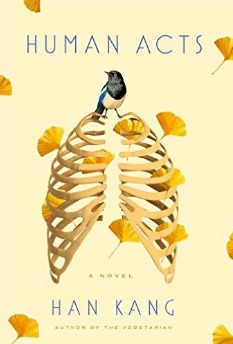
Human Acts revolves around the uprising in Gwangju, South Korea that took place from 18 to 27 May 1980.
Unlike what happened in Tiananmen Square in 1989, the Gwangju Uprising has not received as much international attention. Both started as peaceful student protests before descending into violent chaos led by the army. While many international press were present in Beijing to record the events as they unfolded, there was a media blackout in South Korea and few journalists made their way to Gwangju.
I only came to know of the uprising in the southwestern Korean city when I chanced upon a movie, “A Taxi Driver” starring Song Kang-ho. The sobering film is loosely based on Jürgen Hinzpeter and taxi driver, Kim Sa-bok, who transported the German journalist to Gwangju. Reporting for the ARD broadcaster, Hinzpeter was the only journalist who filmed the violence that unfolded in the city.
Human Acts comprises of seven chapters spanning three decades from 1980 to 2013. Interconnected, each section tells the perspective of someone touched by the Gwangju Uprising. All of them whose lives have crossed paths with Dong-ho, the teenage boy who appears at the beginning of the book. He is helping to clean bodies in a makeshift mortuary while searching for his dead peer and trying to make sense of what is happening around him.
Midway lies the chapters on two civilians who survived vicious torture but are forever scarred. One of them, a former factory girl, remarks:
“There is no way back to the world before the torture. No way back to the world before the massacre.”
The narratives unfold in a quiet, unassuming manner. Underlying much of these is a deep trauma, unspoken terror and brutal violence.
Human Acts goes beyond what had transpired in May 1980, extending to its aftermath. The novel concludes with an epilogue by the “writer” who turns out to be Han Kang herself, a Gwangju native. Her family had moved to Seoul before the uprising. Dong-ho was part of the family who bought their house. His eventual death both opens and ends Human Acts.
 Angelina Hue
Join the Conversation