
I recently finished reading a secondhand copy of Truman Capote’s In Cold Blood, a gripping re-construction of the senseless murder of the Clutter family in 1959 and an investigation into the minds of the the killers, combined with testimonies of those close to them and the deceased.
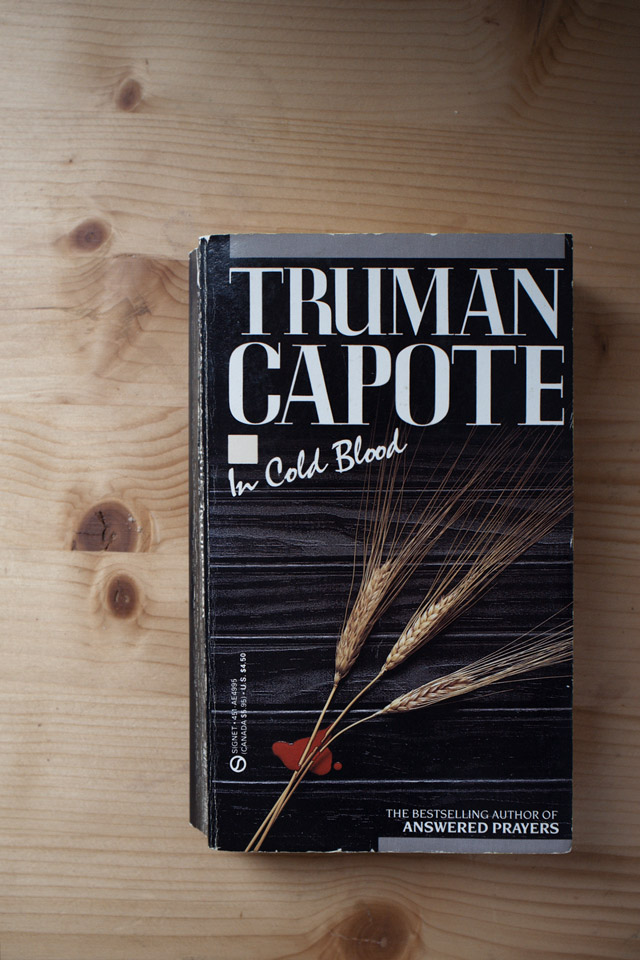
I had picked up this copy of In Cold Blood (published by Signet, 1980) together with a 1975 edition of John Steinbeck’s The Winter of Our Discontent at Nijinski. Both books are excellent and I wouldn’t hesitate to recommend anyone to read them. My only gripe is the unimaginative and cheesy covers of these editions!

When I showed AB the books and lamented about the awful book art, he said that such cheesy book covers remind him of “cereal boxes in the supermarket, shouting for your attention.”
How many times have I returned a book to the shelf or purchased an unknown title because of its cover? Too many times perhaps. I know it’s superficial and one should never judge a book by its cover. But it’s tough to abide by this when faced with such dreadful book designs.
What about you?

This brings to mind an interesting BBC documentary about book design that I had watched sometime back. Titled “The Beauty of Book: Paperback Writer (Part 4)“, this episode focuses on George Orwell’s 1984 and shows how this classic has been reinterpreted by artists through the decades.
Particularly amusing is the sensational cover of the US edition, published in 1954 by Signet, which featured Winston Smith looking like a macho Hollywood star with attention-grabbing headlines and propaganda messages. For more information and observations about this cover, see the video from 07:45.
You can also see an overview of different 1984 book covers at Flavorwire.

I dislike such in-your-face book covers and very much prefer sublime and elegant designs. For instance, those featured in Pushkin Press Collection and published by Persephone Books:


While English book covers tend to be colourful and varied in style, French novels feature a uniformly classic design that is uncluttered with black and red text printed on a white or cream cover. Perhaps the underlying implication is that the contents are so well-written that no marketing or advertising is needed to promote the books.

What is also striking is that this minimalist look hasn’t really changed through the decades. A 1961 copy of Simone de Beauvoir’ Mémoires d’une jeune fille rangée – which I found in an antiquarian bookshop in a small town in the south of France – is a case in point.

If there is any additional design element on the cover of French titles, it would usually be that of a small square image or an abstract drawing. Still keeping it simple.

Broadly speaking, French book art would be unequivocally superior to that of English books.
Except for one major ‘flaw’, which AB pointed out to me: The text on the spine is printed such that it appears upside down when the book is placed face up on the table! Not very practical at all and I wonder why this is so. Any idea, anyone?

 Angelina Hue
Leave a reply to Graham Greene: Stamboul Train | Angelina Hue Cancel reply